A routine drive to an event turned into a life-saving rescue when two motorists stopped to help a cyclist lying beside his bike, only to discover he was in cardiac arrest.
Craig Ormiston, aged 57 suffered a sudden cardiac arrest while cycling towards Brands Hatch on the morning of 21 June 2025 after setting out from the West Malling area on what had started as a beautiful sunny day.
Friends, Emma and Richard were on their way to an event at Brands Hatch when they spotted Craig lying beside his bike at the roadside in a very secluded area. Concerned he may have fallen from his bike, they pulled over to check on him and quickly realised the situation was far more serious.
Craig was unconscious and showing signs of agonal breathing which is an abnormal pattern of irregular, gasping breaths that often occurs during or immediately after a cardiac arrest.
Recognising the signs immediately, Emma, who has experience with the Red Cross and Richard, who held a work place first aid certificate and had further knowledge through marshalling for the BMCRC called 999 at 07:27 and began cardiopulmonary resuscitation (CPR).
While Emma and Richard worked to keep blood circulating around Craig’s body, a team of five in the Emergency Operations Centre rapidly coordinated a major response, dispatching seven clinicians to the scene.
Dave Hawkins said “Cardiac arrest can happen to anyone, at any time and without immediate CPR, a person’s chance of survival decreases by around 10 per cent with every minute that passes before treatment begins and so Emma and Richard’s actions show how vital it is for members of the public to recognise the signs of cardiac arrest.”
Ambulance crews continued advanced life support and delivered two defibrillator shocks before successfully achieving a return of spontaneous circulation (ROSC).
The Air Ambulance Charity Kent Surrey Sussex also attended and sedated Craig before flying him to William Harvey Hospital in Ashford, home to a specialist cardiac unit. Within just 20 minutes of arriving, Craig underwent a procedure to fit a stent to widen a blocked artery.
He then spent three weeks in a coma before eventually waking and beginning his recovery.
Emma said “At the time we just did what anyone would hope they’d do in that situation. The call handler guided us while help was on the way and we just kept going with CPR until the crews arrived. Knowing that those actions helped give Craig a chance is something me and Richard will never forget.”
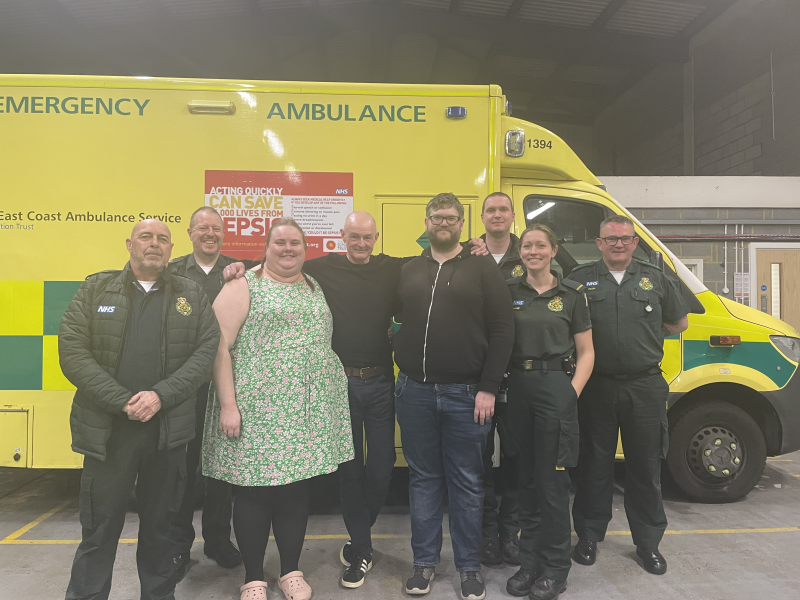
Nine months after the life-changing event, Craig was able to thank those who helped save him during a reunion at Dartford Ambulance Station. He reunited with Emma and Richard again alongside the ambulance clinicians who attended him that day, Operating Unit Manager and Critical Care Paramedic, Dave Hawkins, Paramedics, Aimee Pankhurst and Paul Abdey, Associate Ambulance Practitioner, Graham Seal and Student Paramedic, Mat Allwright.
For Craig, the reunion was an opportunity to personally thank the people who helped give him a second chance at life, but those involved say the real heroes are Emma and Richard.
By recognising the signs of cardiac arrest and starting CPR immediately, they kept oxygenated blood flowing to Craig’s brain and vital organs until emergency crews arrived on scene giving him the best possible chance of survival.
Craig said “I honestly wouldn’t be here today if it wasn’t for Emma and Richard stopping to help me. They didn’t know me but they stepped in and started CPR when I needed it most. I don’t remember anything about that morning so meeting them and the ambulance crews who helped save my life has been special and I’m just so grateful to everyone who played a part in giving me a second chance.”
Paramedic Aimee said “Emma and Richard played a crucial role in saving Craig’s life. Their quick recognition of cardiac arrest and immediate CPR kept blood circulating around his body before we arrived on scene. Early bystander CPR makes a huge difference to survival and Craig’s story is a powerful reminder of how important it is for people to know the signs of cardiac arrest and feel confident to step in and help.”
You can learn how to help save a life like Emma and Richard by learning how to perform CPR and use a lifesaving defibrillator via the British Heart Foundation. Click here to become a lifesaver now.