 Cardiac arrest strikes without warning and when 50-year-old father of two, Gavin collapsed in Maidstone, it was immediate CPR from strangers that ensured he was reunited with his family for Christmas.
On the morning of 10 December 2025, Gavin had walked his daughter to school with their cockerpoo, Milo, before heading home through Penenden Heath. Unbeknown to Gavin, his heart had stopped and he collapsed outside a parade of shops.
With little to no memory of the critical minutes that followed, the next thing he knew he was regaining consciousness in the back of an ambulance on the way to the cardiac specialist unit at William Harvey Hospital in Ashford.
What happened ahead of his journey truly saved his life as two members of the public who witnessed his collapse immediately dialled 999 and started chest compressions.
CPR, otherwise known as cardiopulmonary resuscitation, manually pumps blood to the brain, heart and other vital organs and ultimately buys a patient precious time. It delays tissue death and prevents irreversible brain damage and crucially, it keeps oxygenated blood flowing until a defibrillator can restart the heart.
Consultant Paramedic Julie said “For every minute that passes without CPR, a person’s chance of survival reduces by up to 10 per cent and so in the minutes that we were on our way, every single one of those chest compressions was keeping Gavin’s blood pumping.”
On the line was Emergency Medical Advisor, Alice, who gave clear but strict instructions on delivering high-quality chest compressions to Gavin. At the same time, Resource Dispatcher, Sarah, was mobilising a team of six clinicians to the scene.
First to arrive was Critical Care Paramedic, Andy, who immediately took over compressions, maintaining vital circulation. Consultant Paramedic, Julie, and Operating Unit Manager, Dave, arrived shortly after and confirmed Gavin’s heart was in a shockable rhythm. The team delivered six defibrillator shocks in a determined effort to restore a stable rhythm.
Crewmates and Paramedics, Paul and Nizar, Student Paramedic, Ruby, and Operational Team Leader, Tom, also attended, working seamlessly to ensure they could keep Gavin alive.
It was at William Harvey Hospital that doctors discovered a blood clot in one of his arteries that had triggered the cardiac arrest. Gavin spent two weeks in hospital recovering before returning home just before Christmas to his wife and two young children.
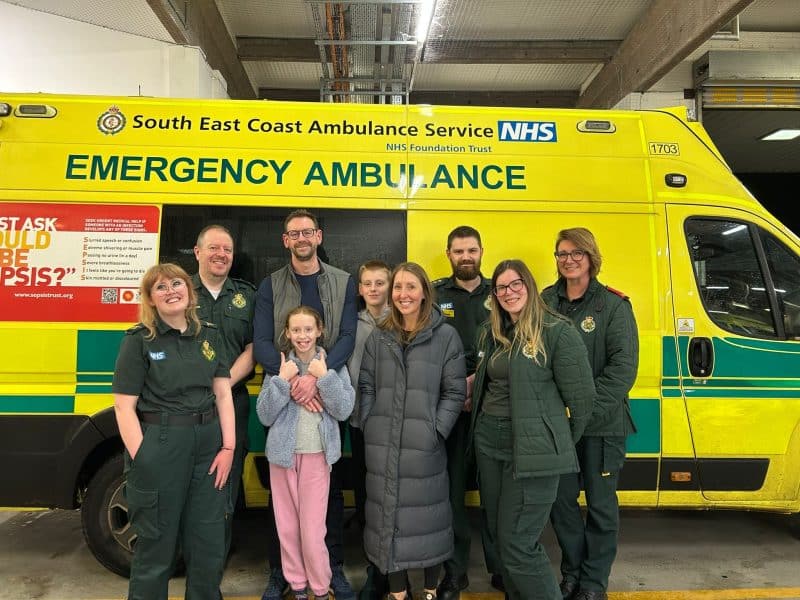
Nine weeks on, he and his family visited Paddock Wood Make Ready Centre to reunite with Alice, Sarah, Julie, Dave and Tom. For the family it was a chance to understand the chain of survival that began with bystanders giving him the best chance of survival.
“If those members of the public hadn’t of had the courage to start CPR immediately, I know I wouldn’t be here,” Gavin said. “Every minute without CPR cuts your survival chances and by someone choosing to push on my chest, that’s the only reason I’m still here with my wife and children.”
Operating Unit Manager Dave Hawkins said Gavin’s survival highlights the critical importance of immediate intervention. “Cardiac arrest is unforgiving. The heart stops, oxygen doesn’t reach the brain and within minutes the damage becomes irreversible,” he said. “High-quality chest compressions in those first few minutes are often the difference between someone walking out of hospital or never going home at all.
“You cannot make the situation worse by starting CPR. If someone is in cardiac arrest, doing nothing guarantees the worst outcome. Starting compressions gives them a chance. Likewise, public access defibrillators analyse heart rhythms and will only deliver a shock if it is required. You cannot harm someone by following the machine’s instructions.”
With plans to return to work soon, Gavin is determined his survival will have a lasting impact. Gavin has already discussed organising CPR training with his teams up and down the country, and will be arranging sessions for his son’s U13 football team.
“If 10 people learn CPR because of what happened to me, that’s 10 more people who could save a life,” he said. “You can’t hurt someone by trying. You can only help.”
In Gavin’s case, it was CPR delivered within seconds by strangers who refused to stand by, guided by a call handler who coached every compression and continued by clinicians who would not give up. We know that we can help arm so many more members of the public with the knowledge of CPR. By sparing 15 minutes, you can learn CPR via the British Heart Foundation with a pillow and a mobile phone or laptop in hand by clicking here.