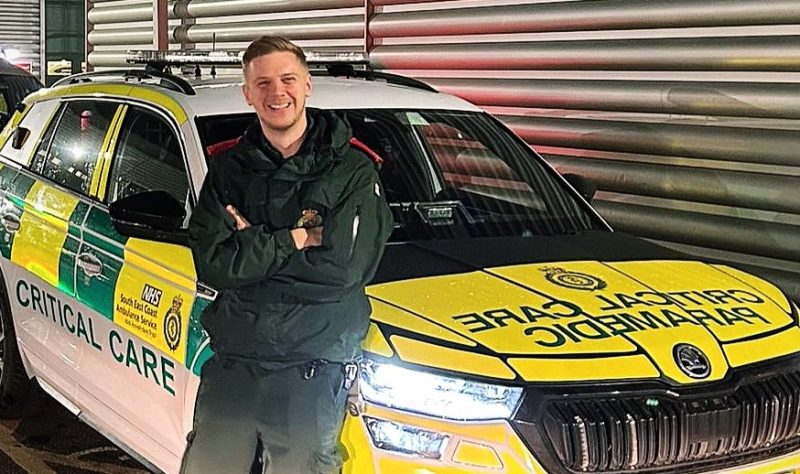
 A South East Coast Ambulance Service (SECAmb) critical care paramedic (CCP) with a passion for improving outcomes for cardiac arrest patients has seen his innovate work published internationally.
Bradley Gander’s literature review, co-authored with Samantha Laws, a senior lecturer at St Georges University of London, studied the complex issue of Pulseless Electrical Activity (PEA) – a particularly challenging type of cardiac arrest where the heart’s electrical system appears to be working but the heart is not effectively pumping blood.
The extensive review, published in the International Journal of Paramedicine, searched medical databases for studies published since 2014 covering a total of close to 10,000 adult patients. It looked to provide insights into the current clinical uncertainty surrounding PEA patients where, because they don’t have shockable heart rhythms, it can be harder for emergency teams to know who is more likely to survive.
The review aimed to establish if certain electrocardiogram (ECG) patterns can provide clinicians with information on which patients have a greater chance of survival.
Its findings included that patients with a narrow ECG reading and those with increasing heart rate during CPR may be more likely to recover.
While the review found further research and data linked to patient outcomes is required, Bradley hopes it can lead to improvements in patient care and help establish particular patterns which could help ambulance crews identify patients with the best chance of recovery.
“I’ve always felt this we should look at this group of patients we look at in more detail to see if we can improve our treatment and outcomes,” said Bradley.
“The review represents an initial step at trying to see if it is possible to stratify this group of patients based on information we can rapidly assess at scene.
“Going forwards, I would love to continue to study this area further and explore whether it may be possible to tailor the treatments we provide to the different subgroups of this condition.”
SECAmb Chief Paramedic Officer, Jaqui Lindridge said: “We are incredibly proud of Bradley’s achievement in securing an international publication, which is testament to his expertise and commitment in studying one of the most difficult areas of cardiac arrest care.
“His work shines a light on how we can make the best decisions we can in cardiac arrest management and look to improve outcomes for some of our sickest patients.”
The review can be downloaded in full here: Electrocardiogram Characteristics as Prognostic Indicators in Pulseless Electrical Activity: A Systematic Review | International Journal of Paramedicine