 When Ellie King’s heart stopped, quick CPR from her husband and rapid response from South East Coast Ambulance Service (SECAmb) clinicians gave her a second chance at life.
On 12 June 2025, Ellie and her husband, Paul, were at home watching television when Ellie’s breathing suddenly became irregular.
“It just didn’t look right,” Paul recalled. “One minute we were watching TV, the next I knew something was seriously wrong.”
Paul called 999 for help immediately. Resource Dispatcher, Elle Playfair, who was a call taker at the time picked up the call and quickly assessed the situation. Calmly, Elle instructed him to move Ellie to the floor and begin chest compressions as further help was arranged.
The call was triaged as a category one incident – the most life-threatening of calls. Within 10 minutes, Newly Qualified Paramedic, Chase Collins, and her crew mate were at the scene, closely followed by Operational Team Leader, Richard Dixon, and critical care paramedics.
“Early response and teamwork are critical in a cardiac arrest,” Richard said. “From the moment we arrived, everyone knew their role and thankfully Ellie’s husband had already given her the best possible chance by starting CPR immediately.”
The team administered a life-saving shock with a defibrillator before taking Ellie to hospital where she spent two weeks recovering.
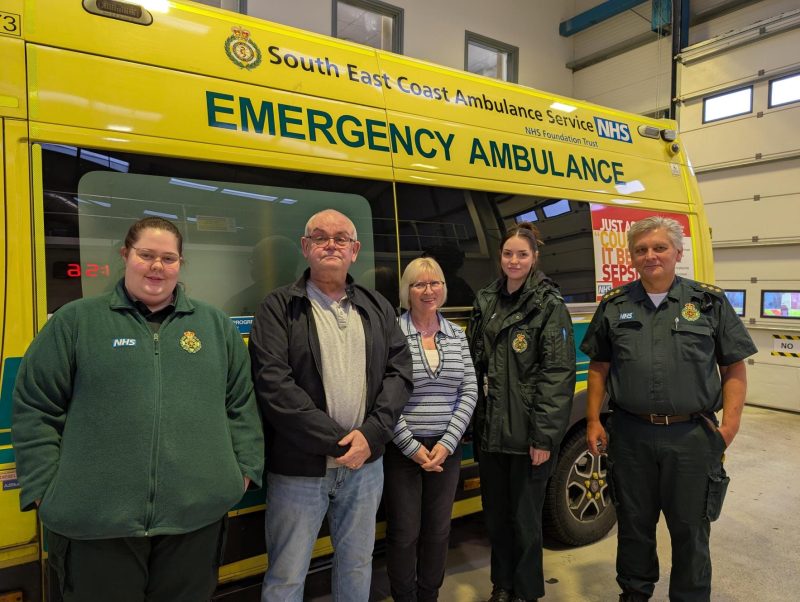
Six months later, Ellie was able to meet some of the people who helped save her life, visiting colleagues including Chase, Elle and Richard at SECAmb’s Tangmere Make Ready Centre.
“I don’t remember any of it, but I know I wouldn’t be here without them,” Ellie said. “My husband, Elle on the phone, and the ambulance crews - they gave me another chance at life. Thank you will never be enough.”
Reflecting on the reunion, Chase added: “Seeing Ellie walk through the door smiling — that’s why we do this job. It’s not often you get to see the outcome, so it was special to meet Ellie again in much better circumstances.”
Ellie’s experience also highlights an important message about cardiac arrest symptoms in women. While many people associate heart problems with severe chest pain, women are more likely to experience subtler signs or like Ellie no symptoms at all. It is important to look out for signs such as shortness of breath, nausea, back or jaw pain, extreme fatigue, dizziness or irregular breathing – symptoms that can be easier to overlook.
“We would urge people to look out for early warning signs which can show up differently in women,” Richard emphasised. “Recognising this early could be the difference between life and death.”
Further resources and information on how to save a life can be found at www.secamb.nhs.uk/cpr