A rare genetic heart condition that often shows no warning signs until it causes a cardiac arrest turned a normal day into a life-threatening emergency for a Hove based family.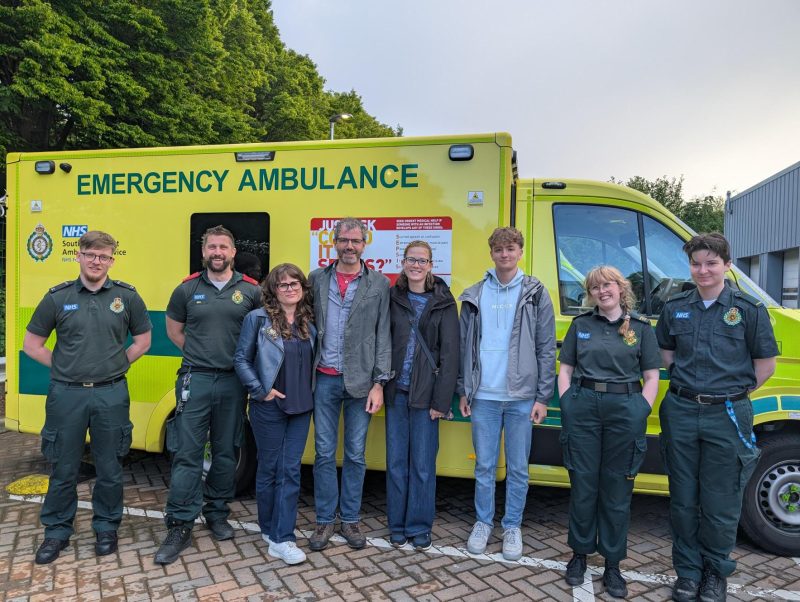
Brugada syndrome, which affects as few as 1 in 2,000 people in the UK, can cause sudden cardiac death and is sometimes only discovered after someone collapses.
This was the case for Andrew Lakey-Porter who went into sudden cardiac arrest at home on 8 March 2026. But the speed and coordination of the response demonstrated how every link in the chain of survival plays a vital role in saving lives.
For every minute without intervention following a cardiac arrest, a person’s chance of survival reduces by 10 per cent. But, thanks to the swift action of his family and SECAmb clinicians, now 51-year-old, Andrew, has been given a second chance at life.
Andrew, his civil partner Dominique, son, Joe, and daughter, Rosa, were at home when Andrew suddenly collapsed and his breathing became irregular.
Dominique called 999 and Emergency Medical Advisor, Alice, answered the call, quickly triaging the incident as a Category 1 – the most life threatening of emergencies.
As Alice calmly guided the family through what to do, Resource Dispatcher, Daniel, coordinated the emergency response and ensured help was on its way.
In those critical first minutes, 15-year-old, Rosa, stepped forward and began chest compressions while Dominique relayed instructions from Alice over the phone.
Within minutes, the first ambulance crew arrived on scene, closely followed by a second crew and Critical Care Paramedic (CCP). Together, the team worked quickly to restart Andrew’s heart, giving him three shocks with a defibrillator, before he was taken to hospital for further treatment.
Andrew was later diagnosed with Brugada syndrome and continues his recovery surrounded by his family. He shared he feels “incredibly lucky” to be alive.
Just over two months later, Andrew and his family were reunited with some of the team who came to their aid, including call taker Alice, dispatcher Daniel, CCP Ben and paramedic Alex.
“It’s overwhelming to think about how many people came together to give me another chance,” Andrew said. “From Dominique making that call, to Rosa starting CPR, to the ambulance crews arriving so quickly – every single person played a part in me still being here today. I’m incredibly grateful and so thankful to my family and everyone who helped me.”
“You never think something like this will happen to your family,” Dominique added. “Since it happened, his friends, work colleagues, neighbours, have provided us much support and made us realise how loved he is and what a big gap he would have left if the outcome was different.
“I wanted to thank you for saving his life, but also to let you know, it’s not just one life you save. His children will have a father for years to come, his mother will have her son who is essential for helping her live independently, his friends and colleagues who rely on him will be able to count on him still. I have been blessed with more years with the love of my life. We deeply appreciate you all and always will.”
Recognising Rosa for her actions, CCP Ben said: “Without Rosa’s intervention, the outcome could have been very different. She gave Andrew the best possible chance of survival and should be really proud of herself.”
The family’s story is a powerful reminder that in a cardiac arrest, every second counts. Early recognition, early CPR, early defibrillation and early advanced care are all critical to improving survival rates and patient outcomes.
Improving survival from cardiac arrest remains a key priority for SECAmb, with a strong focus on strengthening every link in the chain of survival. From rapid call handling and effective dispatch, to empowering the public to act with confidence and delivering expert, high-quality clinical care at the scene, SECAmb is committed to giving every patient the best possible chance of survival and recovery.
To find out how you can learn to save a life and help us achieve this goal, please visit our webpage here: CPR – NHS South East Coast Ambulance Service