Today is World Health Day, which this year is campaigning for science-led solutions for a healthier future.
With today’s research paving the way for the scientific treatments of tomorrow, SECAmb has been developing its own research capacity.
The Research and Development Department held open applications across the Trust, before awarding £3,000 grants to three teams of colleagues with research proposals supporting both the Trust’s Strategy and the Government’s 10 Year Health Plan for England.
“All successful project proposals closely align to the NHS proposed shift from analogue to digital,” said Pete Eaton-Williams, Senior Research Paramedic. “In particular, the adoption of Artificial Intelligence (AI) applications within ambulance setting clinical practice.”
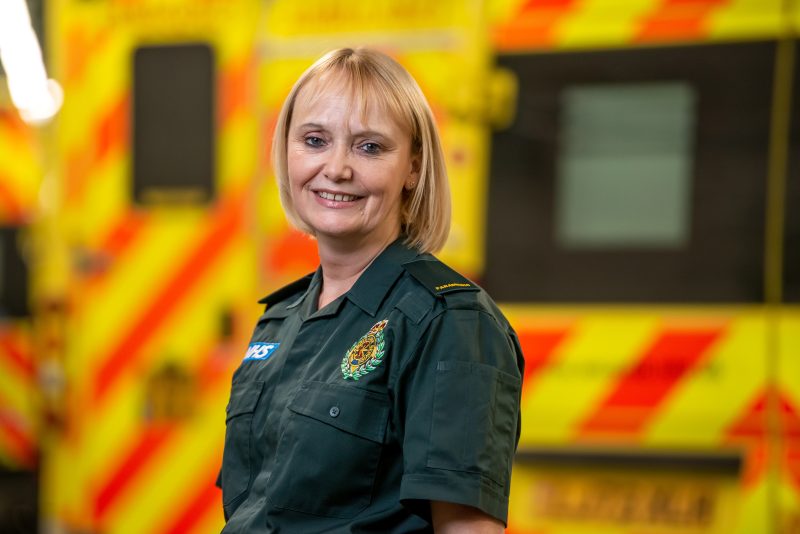
One project aims to understand ambulance crews’ experiences and perceptions relating to AI. Chertsey Paramedic and lead researcher Nicola Buchan said that while AI is rapidly reshaping healthcare, there has been little research regarding how those working in the pre-hospital environment experience or understand it.
“Clinicians are making fast, high-stakes decisions long before patients reach a hospital. Our research dives into how paramedics understand and feel about AI,” she said. “With the NHS pushing hard toward digital transformation, now is the moment to find out whether the workforce is ready, and what support they really need.
“I hope this research project reveals not just how prepared SECAmb paramedics are for AI, but also the hopes, concerns, and practical realities that will shape its safe use in the future,” said Nicola. “The goal is simple: to make sure digital innovation enhances patient care, without losing the human judgement and compassion that define paramedic practice.”
Ashford OTL Tom Whateley is lead researcher for a project looking at emerging digital tools – such as AI-supported documentation and clinical decision aids – that have potential to support our clinicians. The project hopes to discover what works, what doesn’t, and what would need refining before real-world implementation.
“Working in urgent and emergency care, you see first-hand how time pressure, cognitive load, and complex clinical environments can affect both clinicians and patients,” said Tom. “Research provides a structured way to challenge assumptions, test new ideas, and build evidence for improvements that could meaningfully change practice.
“I’m particularly drawn to projects that sit at the interface of people, technology, and clinical care—where small innovations could have a large impact on staff wellbeing and patient outcomes. Being able to shape that future through robust evaluation is incredibly motivating.”
The third project looks at PM Cardio, an AI-based ECG interpretation tool, and how effective such technology is in a pre-hospital environment where diagnostic decisions must be made rapidly and often under resource constraints.
Working on data drawn from across the Trust, researchers will see whether PM Cardio can be practically applied to ambulance service ECG records and whether its classifications align with current STEMI interpretation protocols.
“This observational study will generate the first evidence on the feasibility of applying PM Cardio to ambulance service ECG records. It will assess whether AI-assisted ECG interpretation offers added diagnostic value over current triage protocols, laying essential groundwork for future prospective trials,” said Jonny Williams, project lead and HART operative.
It is hoped the study’s findings will identify practical challenges and generate preliminary data to underpin a grant application for a larger, externally funded study to evaluate PM Cardio AI in real time pre-hospital care.
All three studies will report their findings later this year.