A thought‑provoking paper on violence and aggression against staff from the Trust’s Shadow Board was presented to the Trust Board recently.
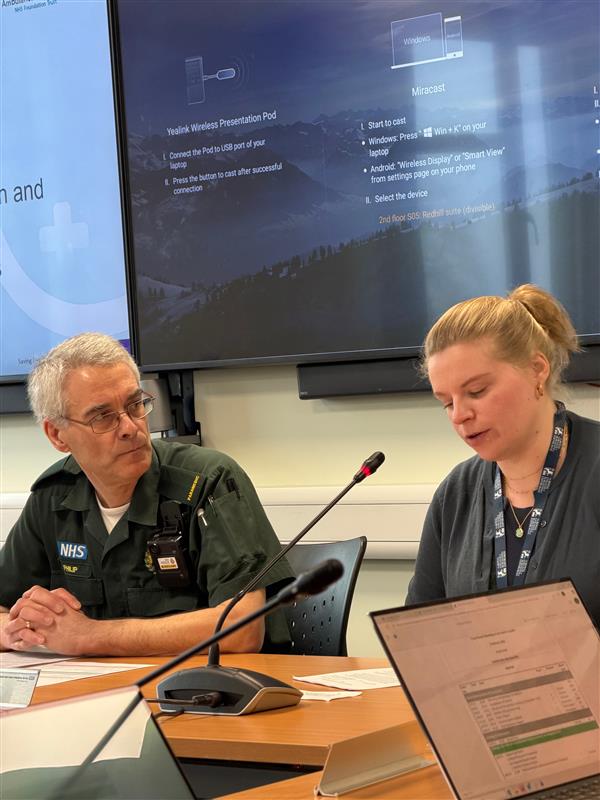
Shadow Board members Philip Taylor, a Banstead Paramedic, and Hannah Sewell, a Dartford Paramedic, delivered the paper on behalf of the Shadow Board, drawing on their first-hand experiences of being verbally and physically abused.
The deep dive into violence and aggression was initiated at the request of Chief Executive Simon Weldon during the December Trust Board meeting.
The Shadow Board was asked for its views on how the organisation should address violence and aggression and what zero tolerance should look like, recognising the need to define it clearly and consider if, or when, care should be withdrawn if a person becomes violent or is known to pose a threat.
Using internal expert insight as well as reviewing committee papers, the Shadow Board developed a number of recommendations aimed at accelerating safety improvements and providing the Trust Board with assurance that every possible step is being taken to mitigate risks to frontline clinicians and colleagues in our contact centres.
The Shadow Board also called for a full review of the Trust’s history marking policy. This policy outlines the process for adding risk markers to the computer‑aided dispatch (CAD) system to alert colleagues to known issues associated with certain patients.
Members of the Trust Board welcomed the report and it was recognised that defining tolerance levels and decisions about withdrawing care is an issue the wider ambulance sector needs to consider.
The Trust Board thanked the Shadow Board for their work and agreed to review progress on this vital area in six months.
You can read the Shadow Board’s paper here.
Philip said: “We on the Shadow Board must thank those who helped inform our discussions and recommendations to the Board.
“We believe that having one executive lead this important area of work will help give it the level of gravitas it deserves.
“Of the 67 per cent of staff who responded to the 2024 NHS Staff Survey, 42 per cent reported experiencing some form of violence or aggression in the previous 12 months. Looking at SECAmb’s data on incidents of violence and aggression this year there were 1,444 reports. This really highlights the scale of the issue.”
During the meeting, Hannah highlighted three incidents in which she had been the victim of violence.
She said: “It may surprise you to know that all three of these patients had been violent and abusive to previous crews. This was not their first abuse of SECAmb staff - they were known risks. Vital learning has been captured around how I could have been kept safer going into these calls.”
Hannah added: “As an expert by lived experience, I wholeheartedly support rewriting the history marking policy and procedure to ensure standardised actions for both EOC and frontline staff when responding to someone with a history of violence or aggression.
“We cannot eliminate all risk, especially unexpected, first‑time violence, but we can ensure we have robust, repeatable processes when responding to people with a known history of abusing Trust staff or colleagues in the wider NHS or partner agencies.”