
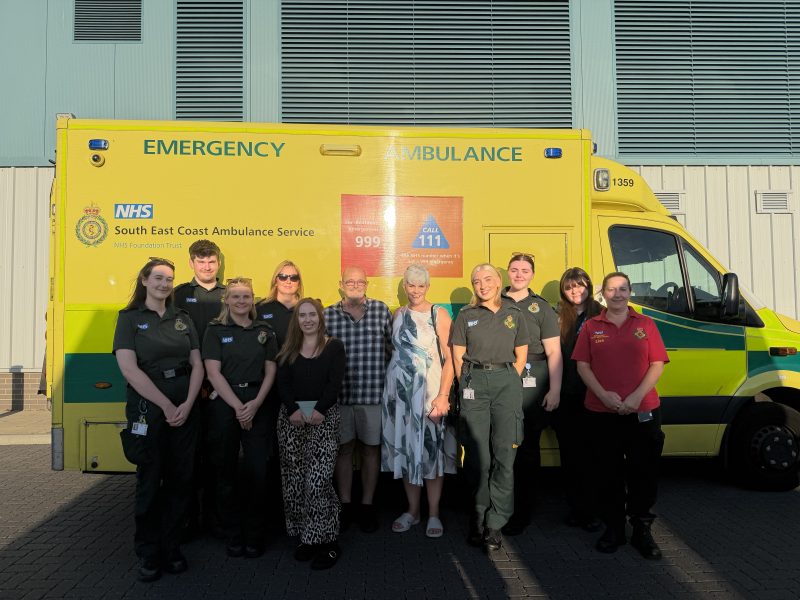
A Kent man who survived a cardiac arrest has met the team who saved his life, as SECAmb celebrates England’s leading cardiac arrest survival rate and works towards an ambitious five per cent improvement.
The latest figures for May 2026, published by NHS England, show SECAmb achieved its highest-ever monthly 30-day cardiac arrest survival rate of 17.2 per cent. This surpasses its previous record of 15.9 per cent, recorded in June and August 2023 and places the Trust top nationally, well above the monthly national average of 10.2 per cent.
For Rob, aged 59, from Lordswood in Kent, those figures represent something deeply personal – a future he almost lost. Recently he came face to face with the team whose actions helped make that possible.
It was while Rob was washing his car at the family home on 18 May 2026, that he started experiencing symptoms of a cardiac arrest – numbness in his arm and chest pain. His wife, Sue, immediately called 999.
Getting help to Rob as quickly as possible, Resource Dispatchers, Amie and Emily, based at the Gillingham Emergency Operations Centre (EOC), sent Community First Responder (CFR), Lisa to the family’s home.
Paramedic, Georgia and Associate Ambulance Practitioner, Jenni arrived shortly afterwards and while they were assessing him with CFR, Lisa, Rob deteriorated and went into cardiac arrest in front of them.
Paramedic, Cameron and Associate Ambulance Practitioner, Grace joined the resuscitation effort, alongside Critical Care Paramedic, Chris who provided an anaesthetic bundle to support Rob’s recovery and help protect his brain following the cardiac arrest.
The team of six initially restarted Rob’s heart, however he went into cardiac arrest a further six times. Crews continued treating him at the scene, as they worked to achieve a sustained return of spontaneous circulation (ROSC).
Nearly two hours after Sue’s original 999 call, Rob’s heart regained a regular rhythm and he was taken to William Harvey Hospital where he underwent emergency surgery to remove a blockage from an artery.
Paramedic, Cameron said “Seeing Robert walk into the room was a great feeling. Considering the last time I saw him he was post cardiac arrest and still suffering from a heart attack, Robert's outcome demonstrates how vital early recognition, early CPR, early defibrillation and rapid transfer to advanced care are to a patient's survival in cardiac arrest. This incident is a prime example that shows how good interagency working and strong teamwork provides the absolute best outcome for our patients.”
However, the road to recovery was rocky and within a month of leaving hospital, our crews were called on to help Rob after suffering chest pains. With the help of Associate Ambulance Practitioner, Holly and Paramedic, Lucy attended, Rob was taken to Medway Maritime Hospital for further care. Just 10 weeks after the cardiac arrest that nearly claimed his life, Rob visited Medway Make Ready Centre to meet his lifesavers, getting to thank Lisa, Georgia, Jenni, Cameron, Grace, Holly, Lucy, Amie and Emily in person.
The reunion gave Rob the opportunity to learn more about the extraordinary efforts made to save him which he has little memory of, as well as the team able to hear about his treatment and recovery after he left their care.
Rob said “Without all of their help the outcome could have been a different story I'm sure. I will be forever in their debt.”
Rob’s experience demonstrates the importance of every link in the chain of survival – from recognising that something is wrong and calling 999 to rapid community response, resuscitation, advanced clinical care and specialist hospital treatment.
For every minute someone remains in cardiac arrest without CPR and defibrillation, their chance of survival decreases by approximately 10 per cent. Immediate action can therefore make the difference between life and death. You can learn CPR by clicking here.
To read more about our strategy and goal to increase cardiac arrest survival by 5 per cent by 2029, click here.