A Kent man who survived a cardiac arrest and 14 defibrillator shocks has married Tracy, his partner of more than 20 years, who helped save his life.
When Bill suddenly lost consciousness at home on 19 May 2026, the snoring-like sounds he made led Tracy, now his wife, to believe he might be having a seizure. But the Emergency Medical Advisor, Isabelle answering her 999 call recognised a sign of cardiac arrest – agonal breathing.
These abnormal gasps or slow, laboured breaths can be mistaken for normal breathing. Recognising them is vital and someone who is unresponsive and not breathing normally needs an immediate 999 call and CPR, with guidance from the call handler.
For Bill, from Matfield in Kent, that recognition meant Tracy could begin chest compressions before ambulance crews arrived.
Isabelle said “Tracy did an incredible job in extremely frightening circumstances. She listened carefully, followed every instruction and started chest compressions when Bill needed them most. It was very special to meet them both and see how well Bill is doing.”
Critical Care Paramedics, Josh and Chris were the first clinicians to arrive and found Bill in cardiac arrest with ventricular fibrillation, a life-threatening abnormal heart rhythm. They immediately began advanced life support, including defibrillation and the administration of anti-arrhythmic medication.
They were joined shortly afterwards by Student Paramedic, Leander, Paramedic, Katie and Advanced Paramedic Practitioner, Taryn.
The team delivered one defibrillator shock as they worked to restore Bill’s heart rhythm and stabilise his condition. Once he was stable enough to be moved, they carefully extricated him from his home and took him under blue lights to the specialist primary percutaneous coronary intervention (PPCI) centre at William Harvey Hospital in Ashford. While on route, Bill’s heart went back into a shockable rhythm and a further 13 shocks were given before achieving a return of spontaneous circulation (ROSC).
At the hospital, Bill underwent a procedure to fit a stent and reopen a blocked artery. He was also fitted with an implantable cardioverter defibrillator, which can deliver a shock to restore a normal heart rhythm if another dangerous rhythm occurs.
Reflecting on the response that saved him, Bill said “I can’t thank Tracy and the ambulance team enough for everything they did for me. Without their quick actions, I might not be here today.”
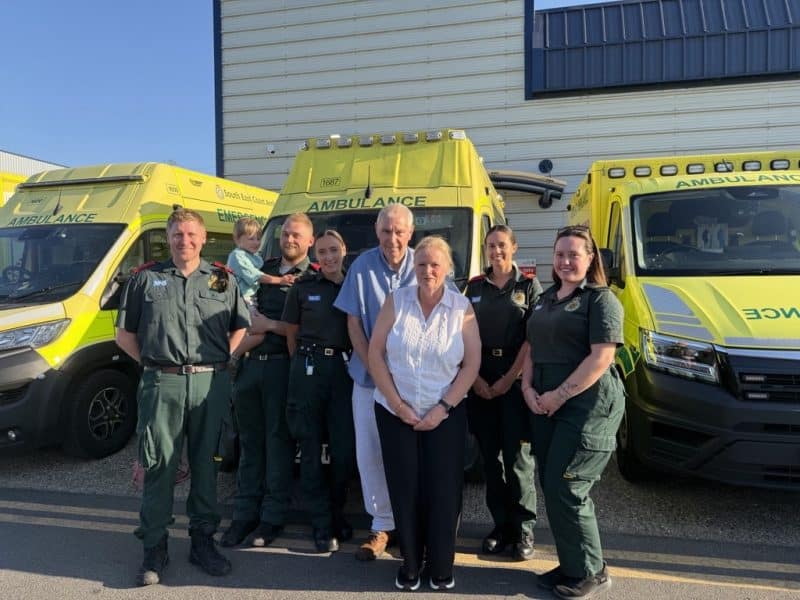
Three months after his cardiac arrest, Bill and Tracy visited Paddock Wood Make Ready Centre, where they were reunited with Josh, Chris, Isabelle, Katie and Taryn.
After more than two decades together, Bill and Tracy have now tied the knot – a milestone made possible by her quick actions and the team who helped bring him home.
Agonal breathing can sound like snoring or gasping, with slow, irregular or laboured breaths. These sounds are not normal breathing and can be a sign of cardiac arrest.
If someone is unresponsive, call 999 immediately and put your phone on loudspeaker. If they are not breathing normally, start CPR and follow the call handler’s instructions. Don’t wait for the gasping to stop before acting.