A football fan whose life was saved after suffering a cardiac arrest at a match is urging others to learn CPR as he reunited with the ambulance clinicians who gave him extra time.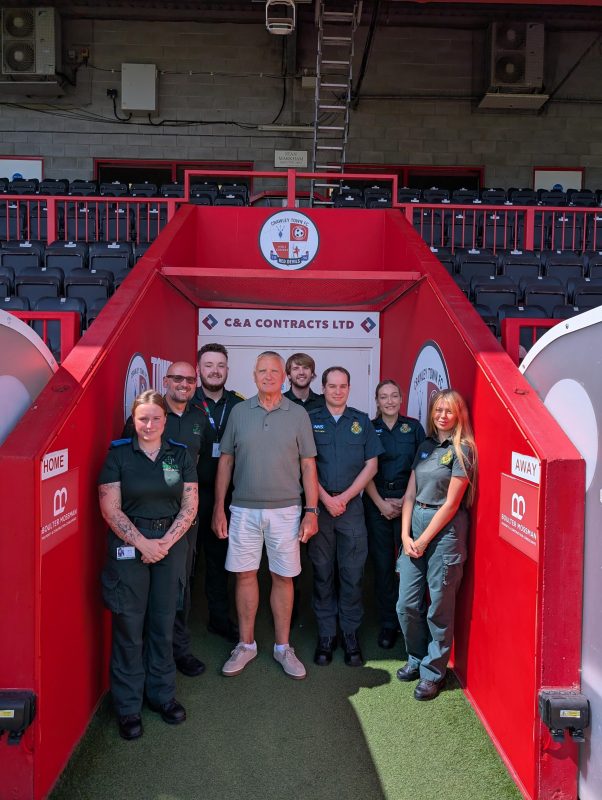
Birmingham City supporter Steve Poulter, now 67, was attending his team’s away fixture against Crawley Town Football Club on Monday, 23 December 2024 when he suddenly collapsed and stopped breathing.
Thanks to the swift actions of those around him, including the event medical team from Revive Medical Solutions and South East Coast Ambulance Service (SECAmb), Steve was resuscitated and taken to hospital.
The response began when Steve’s friend alerted Revive Medical Solutions staff, who were providing medical cover at the game, and rushed to Steve’s aid. Student Paramedic Jack Nelson alerted SECAmb’s Emergency Operations Centre (EOC), where Emergency Medical Advisor (EMA) Daisy Burrows informed dispatch to arrange ambulance resources to the stadium.
Following treatment at the scene, Steve was taken to Royal Sussex County Hospital in Brighton, where he spent 19 days recovering.
SECAmb Critical Care Paramedic, Laini Marshall said: “Steve’s story highlights the importance of early recognition, CPR and defibrillation when someone suffers a cardiac arrest. This was a real team effort, involving the event medical team, our emergency operations centre, ambulance crews and hospital colleagues. Seeing Steve back with his family and enjoying life again is exactly why improving cardiac arrest outcomes is so important."
HART Team Operative, Matthew Dale, who attended the incident, praised the quick-thinking staff at Crawley Town Football Club.
"A big shout out to the stewards and events team who helped clear the area and ensured we could get vehicles in quickly. Their support made a real difference during a time-critical emergency."
Cardiac arrest remains one of the most time-critical medical emergencies. Nationally, around 10 per cent of people who suffer an out-of-hospital cardiac arrest survive to 30 days. Improving survival from cardiac arrest is a key priority for SECAmb, which currently has a leading survival rate in England.
Steve’s story highlights the difference early CPR, defibrillation and a coordinated emergency response can make, giving survivors the chance to spend more time with those they love.
Reflecting on the incident, Steve said he has little memory of what happened that day but remains incredibly grateful to everyone involved in saving his life.
Since his recovery, he has been able to return to activities he enjoys, including taking a reorganised ski trip that had initially been postponed and supporting his football team at more games.
Several months on from the incident, Steve was able to meet some of the team including Laini, Matthew, Daisy, Jack and Revive event medical staff Cerys Davies, Gary Spray and Kayne Loft involved in his care. The reunion provided an opportunity for him and his family to personally thank those whose actions helped save his life.
Steve said: "I'm incredibly grateful to everyone who helped me that day. Without their quick actions I wouldn't be here. It means so much to be able to meet the people who gave me extra time with my family and friends."
The experience has also had a lasting impact on his family. Inspired by the actions of those who helped save Steve, family members have since learnt CPR through initiatives linked to Birmingham City Football Club and are urging more people to learn this life-saving skill.
Steve’s wife Judy said: “I was at home, several hours away and had no idea anything had happened. The first thing I noticed was that the match had been delayed, but I didn't think too much of it. Then Steve’s friend who was with him started trying to contact us and that's when we began to realise something was seriously wrong.
"It was a terrifying time not knowing whether Steve would be okay. To now have him back home with us is incredible and we're so grateful to everyone who helped save his life. As a family, we have since learnt CPR and I really encourage everyone to learn if they can. You never know when someone you love might need your help and it could make all the difference."
Across the South East, members of the public can help strengthen our community resilience by learning CPR and knowing where their nearest defibrillator is. Taking action in those critical first few minutes can make all the difference and potentially give someone extra time with their loved ones.
SECAmb is also encouraging people who are trained in CPR to sign up to GoodSAM, an app that alerts nearby volunteer responders to life-threatening emergencies such as cardiac arrests. This allows trained members of the public to begin potentially life-saving interventions while ambulance crews are on their way.
Daughter, Johanna, also added: “As an ICU nurse, I understand how critical those first few minutes are when someone suffers a cardiac arrest, but having it happen to your own dad is completely different. We're incredibly grateful to everyone involved in giving us more time with him.
"What happened to my dad is a reminder that cardiac arrest can happen to anyone, at any time. CPR is a simple skill that anyone can learn and it can genuinely mean the difference between life and death. I would encourage everyone to take the time to learn it because one day you could save someone's parent, partner, friend or child."
To find out more about learning CPR or becoming a GoodSAM responder, please visit www.secamb.nhs.uk/cpr.