A 999 call handler’s ability to recognise a life-threatening sign of cardiac arrest helped save the life of a grandfather after his wife reported that he was still breathing.
When wife, Pam called 999 after finding her husband Jim unconscious at home on 23 January 2025, she believed he was breathing. The noises Pam could hear sounded like snoring but Emergency Medical Advisor, Carla, knew that what Pam was describing was something far more serious.
When Pam was first asked if Jim was breathing, she said ‘no’. A few minutes after starting CPR, Carla asked again, and Pam stated ‘yes’ because Jim appeared to be breathing, although what she was hearing was actually agonal breathing.
Recognising the sounds as agonal breathing, an abnormal breathing pattern commonly associated with cardiac arrest, Carla immediately identified that Jim was in fact not breathing normally and needed urgent, life-saving help, triggering a Category 1 ambulance response.
Speaking after the reunion, Carla said: "Agonal breathing can easily be mistaken for normal breathing. When Pam described what she was hearing, I knew Jim wasn't breathing normally and needed immediate help. To meet him and his family 18 months later was incredibly special."
Jim’s survival is a powerful example of how early recognition, quick action and effective teamwork can save lives. Improving survival rates for people who suffer a cardiac arrest is a key focus for the Trust, which has committed to increasing cardiac arrest survival by five per cent over as part of its 2024-2029 strategy.
Remarkably, exactly one year earlier, Jim and Pam had completed a local CPR and defibrillation course. Drawing on that training and Carla’s guidance, Pam immediately began chest compressions and continued until ambulance crews arrived.
Critical Care Paramedic, Geoff and Newly Qualified Paramedic, David were first on scene, arriving within minutes. They were joined shortly afterwards by Paramedic, Lauren and Trainee Associate Ambulance Practitioner, Kerry.
Together, the team delivered advanced life support including three defibrillator shocks and successfully achieved a return of spontaneous circulation.
Jim was taken to William Harvey Hospital, where unbeknown to Pam he suffered a further cardiac arrest and spent time in a coma before eventually making a remarkable recovery and returning to full health.
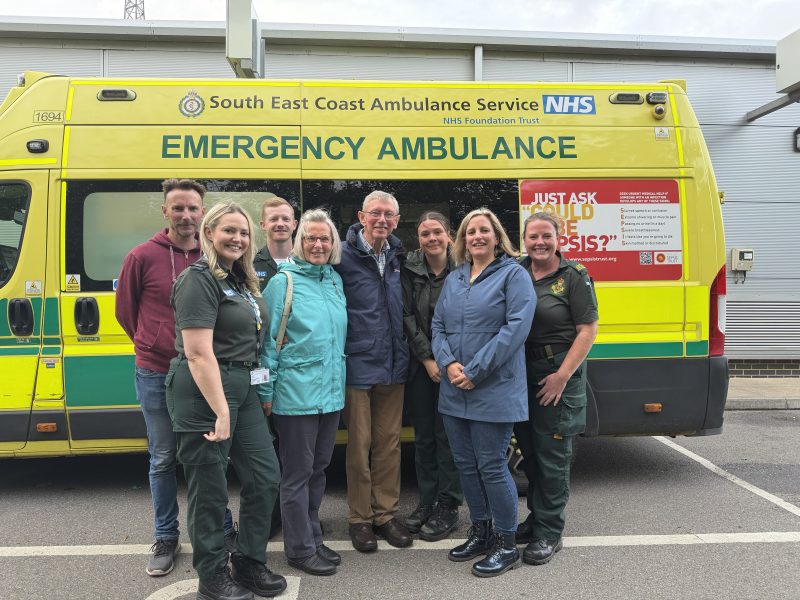
18 months later, Jim was reunited with Carla, David, Lauren and Kerry during a visit to Thanet Make Ready Centre. The reunion also marked the first time Carla has ever met a patient whose life she helped save.
Pam added: "Without Carla recognising what was really happening and telling me what I needed to do, things could have turned out very differently. It meant so much to finally meet her and the fantastic ambulance crews and thank them in person. What a team effort."
During the reunion, Carla presented Pam with a Restart a Heart badge in recognition of the CPR she delivered before ambulance crews arrived, ensuring she was Jim’s heart while he stopped breathing.
Jim said: "I'll always be grateful to Carla, the ambulance crews and everyone involved in my care. Being able to meet them and say thank you was something I've wanted to do ever since it happened."
Jim’s story highlights the importance of recognising the signs of cardiac arrest and acting quickly. Some people may display agonal breathing, which can sound like gasping, snoring, snorting or laboured breathing. Although it may appear that the person is still breathing, agonal breathing is a medical emergency and should be treated as a cardiac arrest.
Paramedic, Lauren said: "Cardiac arrests are among the most challenging incidents we attend and positive outcomes rely on every link in the chain of survival working together. From Carla recognising the signs of cardiac arrest during the 999 call, to Pam starting CPR immediately, through to the care provided by us and hospital teams, everyone played an important role.
"To see Jim doing so well and enjoying life with his family again is exactly why we do this job. It's a reminder of the difference that early recognition, early CPR and rapid treatment can make.”
If you think someone is in cardiac arrest:
- Call 999 immediately.
- Start CPR as soon as possible.
- Ask someone to locate the nearest defibrillator.
You can be the difference between life and death by learning CPR in 15 minutes via The British Heart Foundation.